All-In · Poker Dojo
All-In · Poker Dojo is a free Texas Hold’em trainer for people who want to actually get better at the game, not just pass the time. You sit at a six-seat table, play hands against five bots with different personalities, and after every decision a coach tells you whether it made money — and explains why, in ordinary words.
It runs in your browser, or as a proper desktop app on Mac, Windows and Linux. No account, no ads, no real money, nothing sent anywhere. Everything you play stays on your own machine.
Play it in your browser · Download for desktop
Why I built it
Most poker software does one of two things. It deals you cards and lets you click buttons — fun, but you learn nothing, because nobody ever tells you the hand you just won was a bad call that got lucky. Or it buries you in charts written by professionals for professionals, where a sentence like “you’re laying a caller 20% — the equity they need to call” is apparently meant to be self-explanatory.
I showed that exact sentence to a few people who play poker socially. Not one of them could tell me what it meant.
So I wanted the third thing: software that plays a real hand with you and then explains the decision the way a patient friend would. Not dumbed down — all the maths is still there if you want it — just said in words a beginner can follow. Every explanation in the app now starts as a plain sentence. If you want the arithmetic, you open it. If you want the deeper reasoning, that’s another click down.
The coach talks like a person
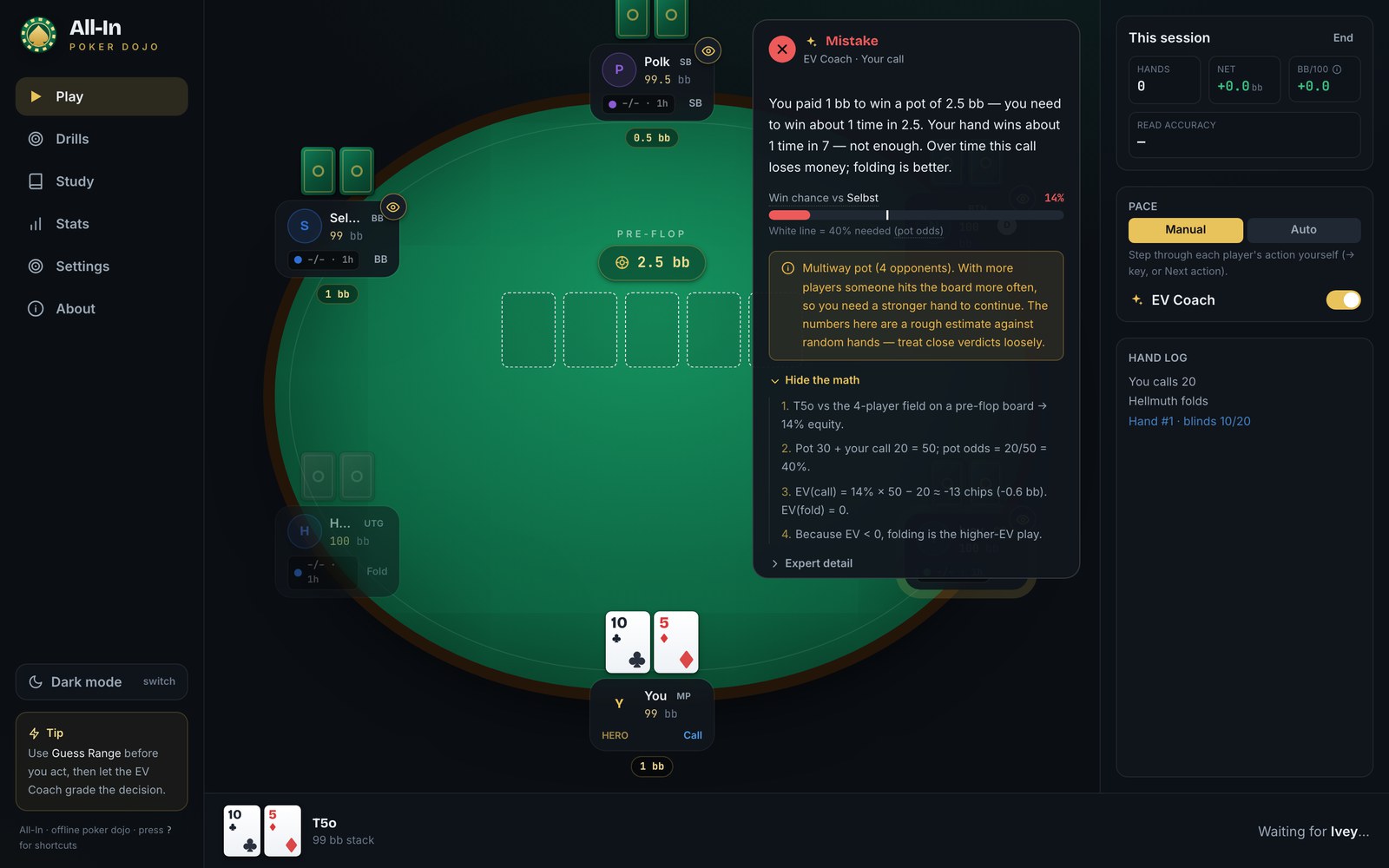
Here’s a real note from the screenshot above, word for word:
You paid 1 bb to win a pot of 2.5 bb — you need to win about 1 time in 2.5. Your hand wins about 1 time in 7 — not enough. Over time this call loses money; folding is better.
That’s it. No vocabulary test. (A “bb” is one big blind, the forced bet that starts each hand. Poker measures everything in big blinds so the advice reads the same whether you’re playing for matchsticks or money.)
Underneath that sentence sits Show me the math — the four lines of arithmetic that produced the verdict, so you can check the coach rather than trust it. Under that sits Expert detail, for when you want the version a serious player would say.
The coach grades every decision you make: folds, calls, raises, and the checks where you should have bet. It also reads the bots for you — ask it why a player just raised and it will tell you what that action usually means.
You see everyone’s cards at the end of every hand
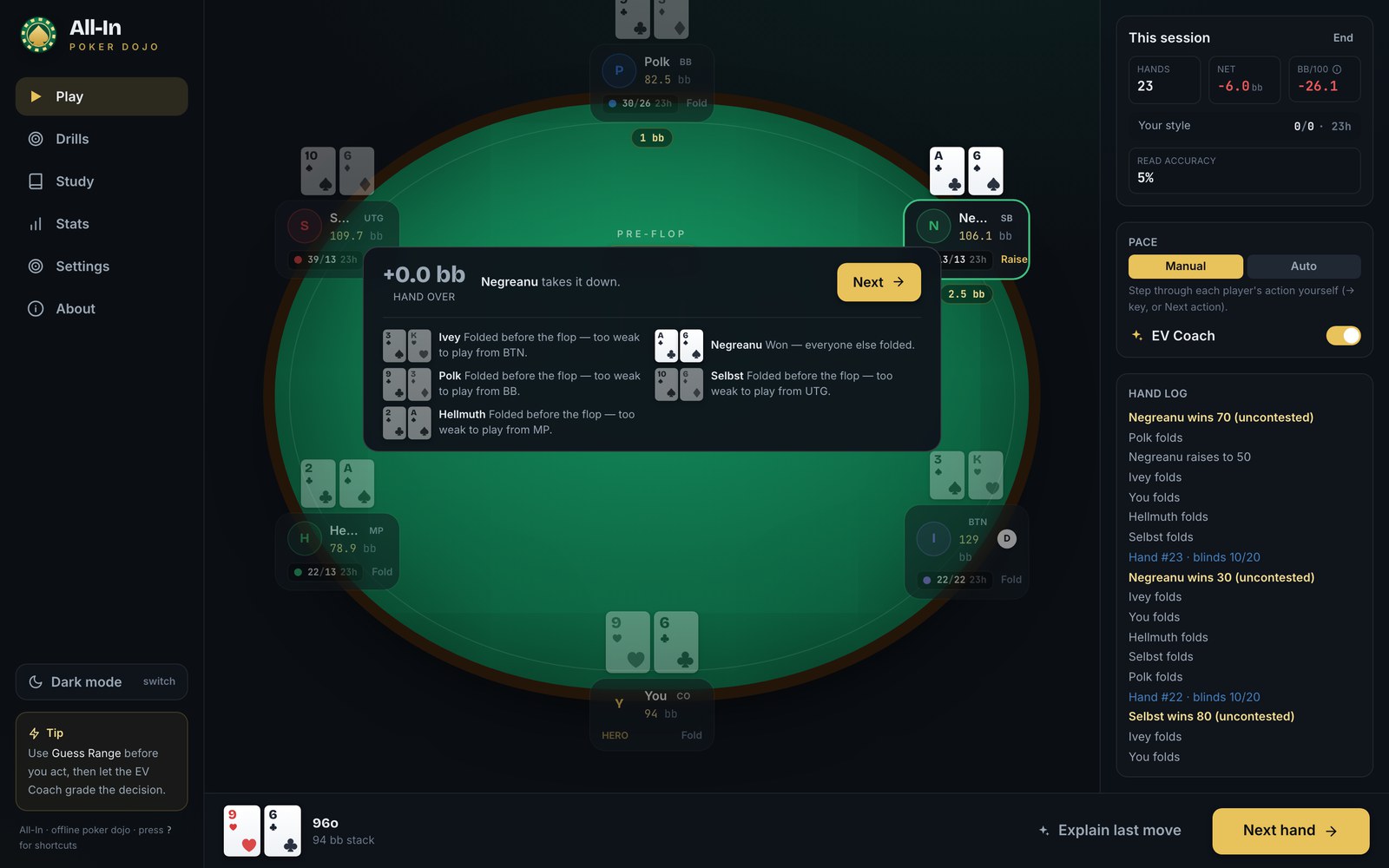
This is the feature I most wanted for myself. In a real game, the players who fold muck their cards face-down and you never find out what you were up against — which is exactly the information you need to learn from the hand.
Here, when a hand ends, every player’s cards turn face-up, folders included, each with a line saying what they did and why. “Folded before the flop — too weak to play from under the gun.” Over a few hundred hands you stop guessing what other people are holding and start knowing.
Nothing is revealed while the hand is still live, so the game stays honest.
Four ways to use it
Play
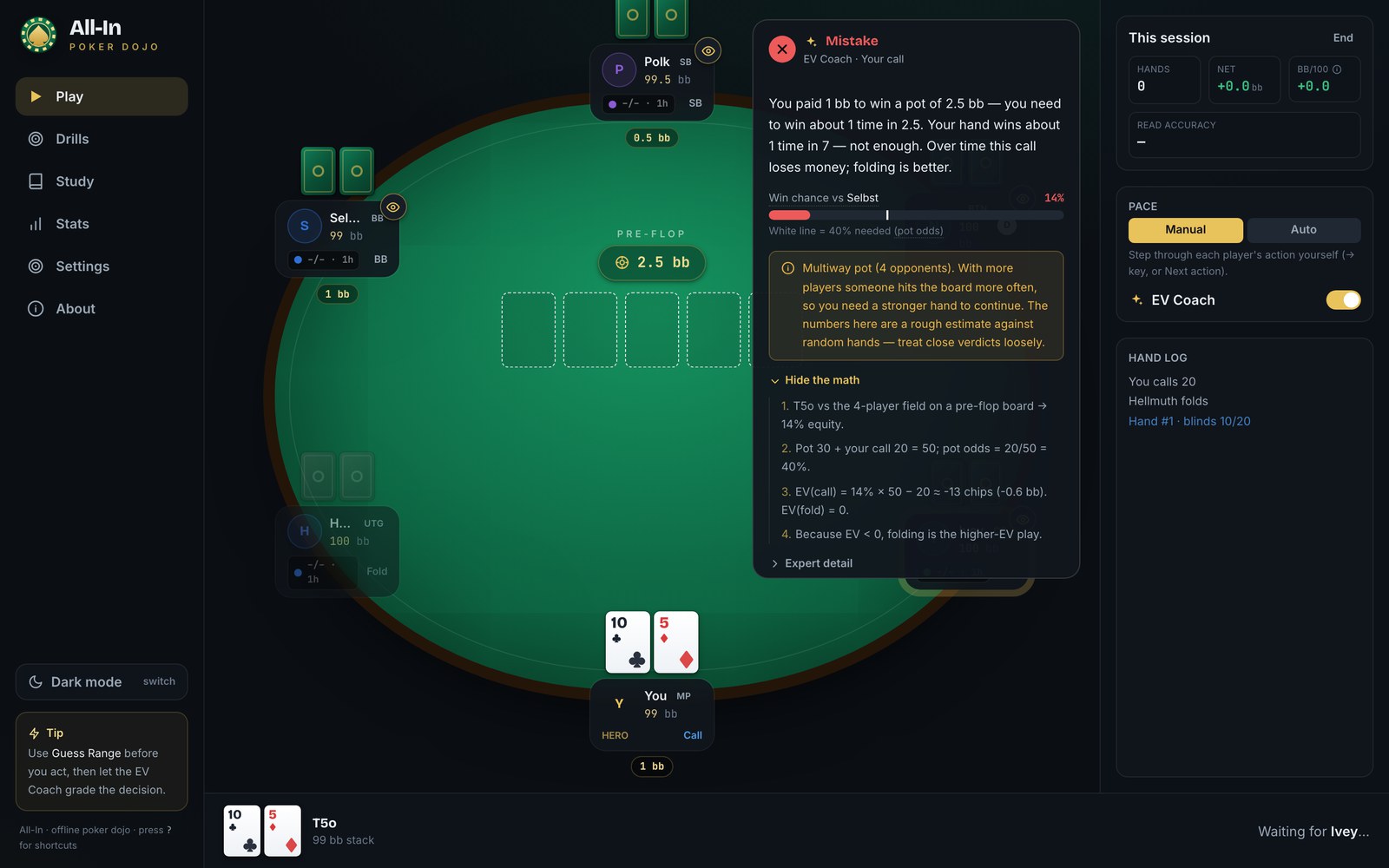
Full hands against five bots, each with a different style — one plays far too many hands, one only plays premium cards, one calls everything. You can step through the action one player at a time to see what’s happening, or let it run at speed. Before you act, you can guess what a specific opponent is holding and get scored on how close you were.
Drills
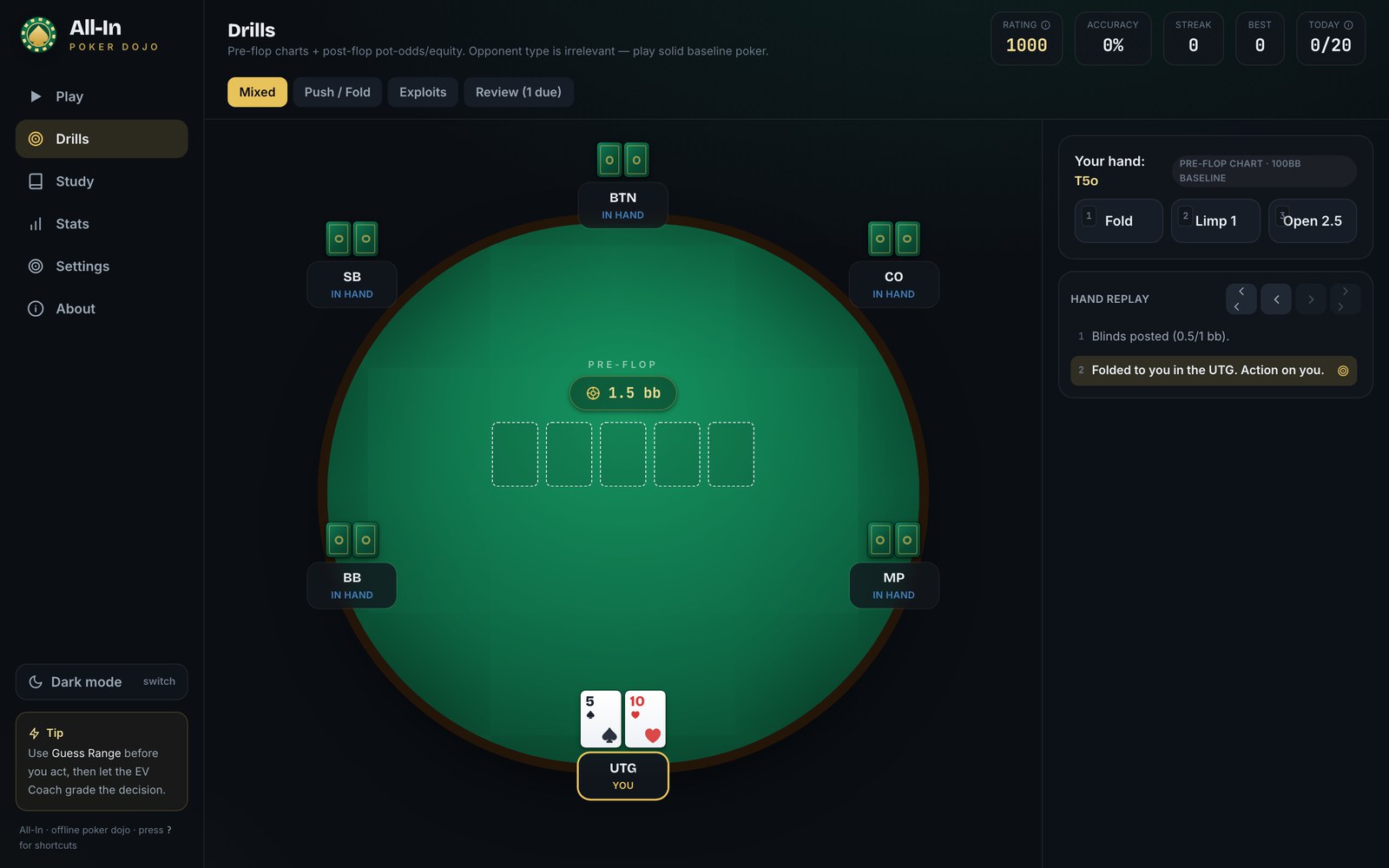
Chess-puzzle-style practice: one decision, instant feedback, a rating that goes up and down with you and quietly gets harder as you improve. There are drills for standard play, for short stacks (when you’re down to a few big blinds and the choice is push or fold), for exploiting specific opponent types, and a Review queue that re-serves your own past mistakes until you stop making them.
Study
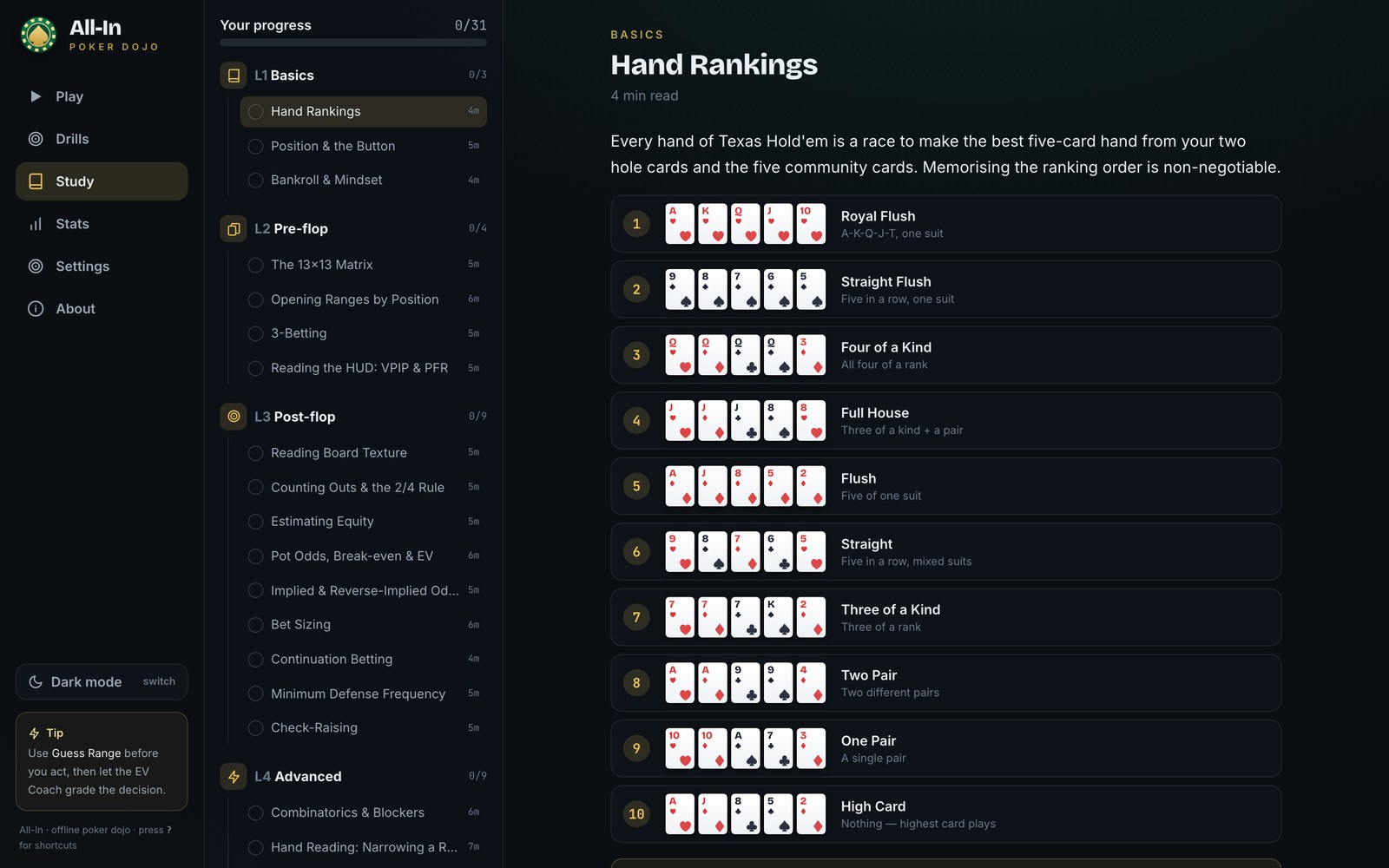
A 31-lesson course, from “which hand beats which” up to the genuinely advanced stuff, with a running progress bar so you can see where you are. Every lesson is short, and any term you don’t recognise has a dotted underline — hover it for a definition.
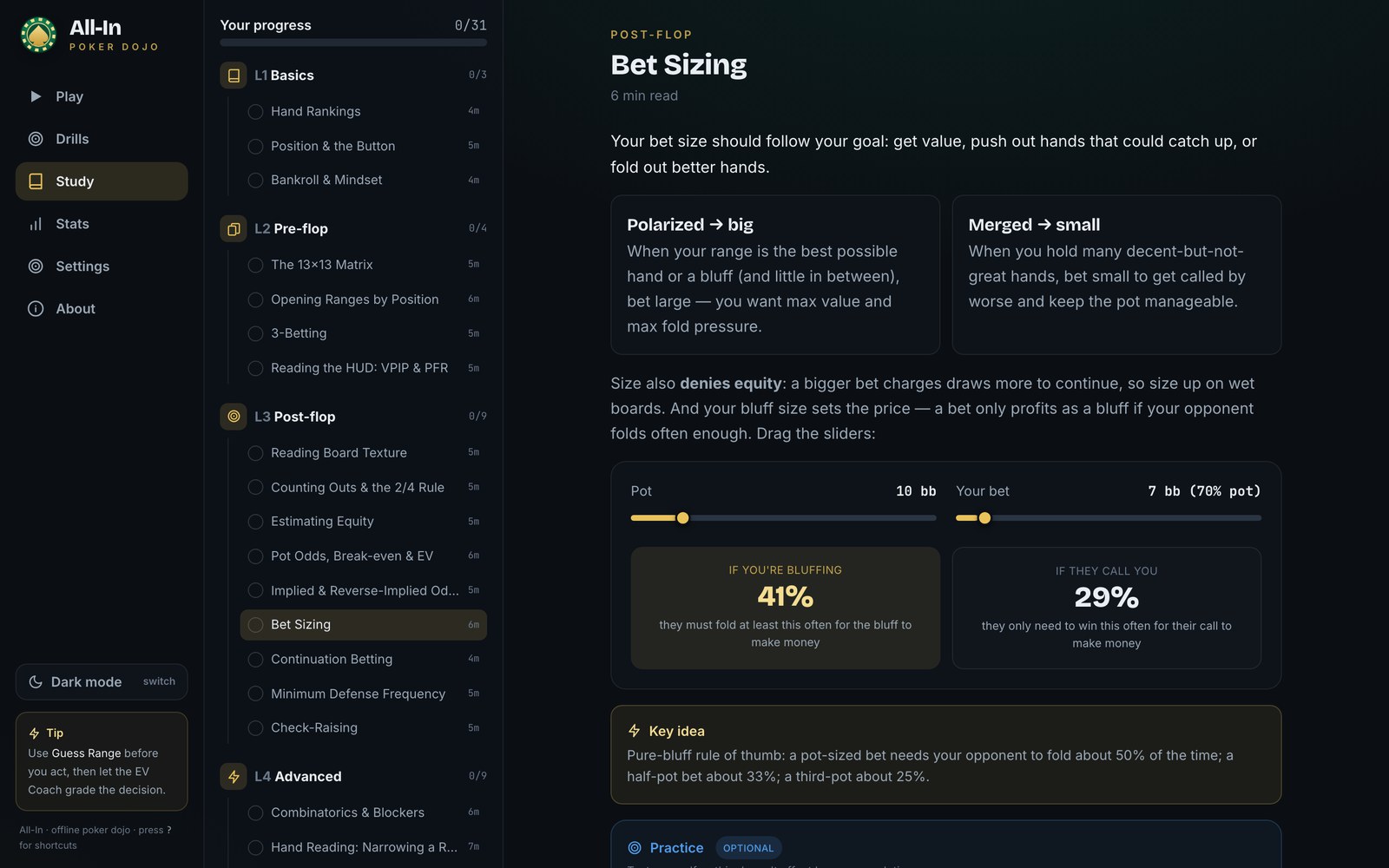
The lessons with numbers in them come with a calculator you can drag. Change the pot, change the bet, and watch the answer move:
Stats
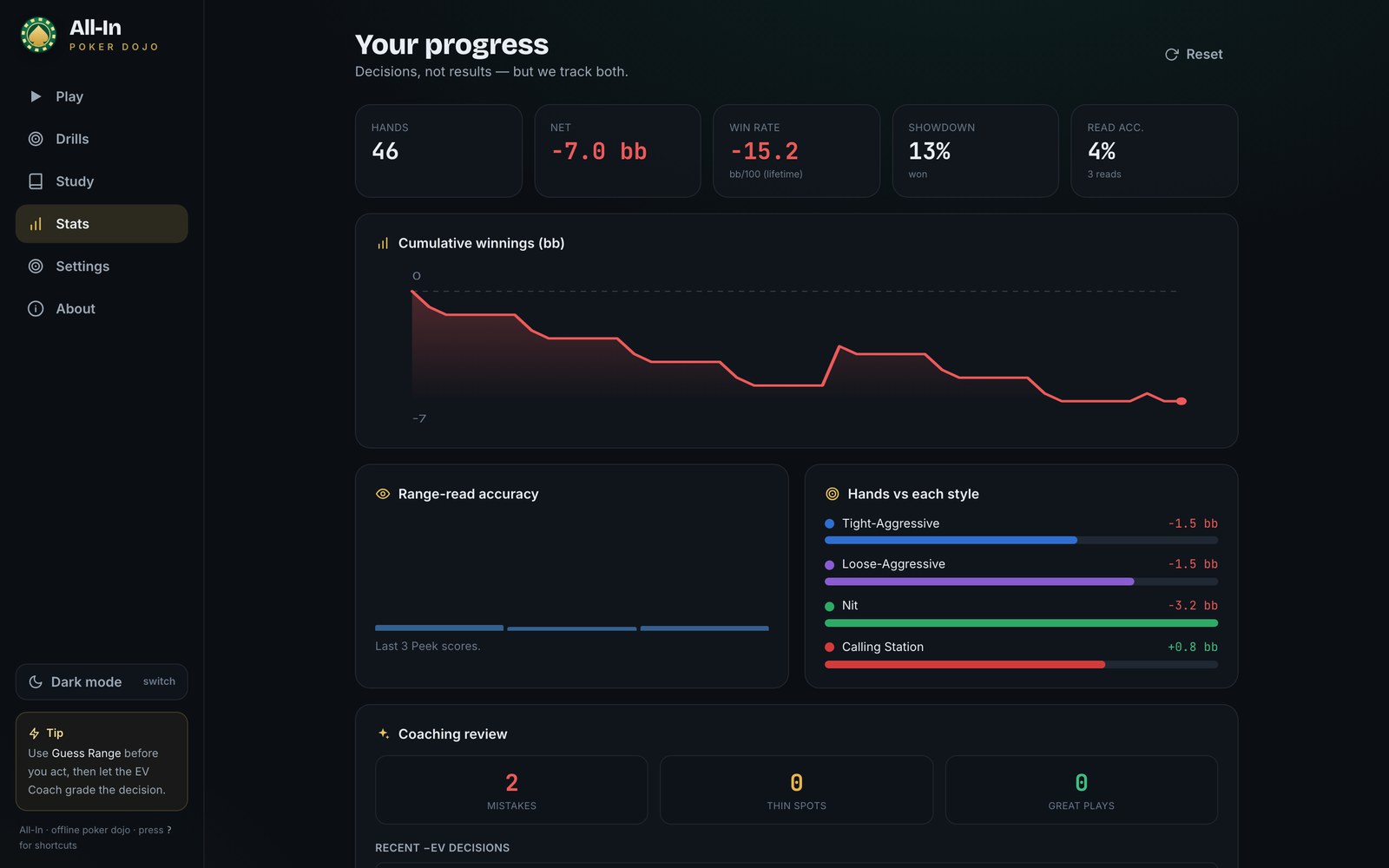
Your results over time, but more usefully: how you do against each type of opponent, how accurate your reads are, and a coaching review that names the specific leaks in your game in one sentence each (“you call too wide for the pot odds — fold your weakest hands more”). You can replay any hand you’ve played, step by step.
The details that matter
- Free, and free of nonsense. No account, no subscription, no ads, no real money, no upsells.
- Genuinely offline. Once installed it never needs the internet. Nothing you play is uploaded anywhere.
- Honest about itself. The About page inside the app explains exactly where each “right answer” comes from and how much to trust it. Some verdicts are near-certain maths; others are estimates, and it says so.
- Play at your own table. Heads-up, 6-max or 9-max, with or without antes.
- Keyboard-friendly. Play a whole session without touching the mouse.
- Light and dark mode, and a four-colour deck if you find suits hard to tell apart.
Getting it
Play it right now in your browser at gapp.in/poker — nothing to install.
For the desktop version, grab the installer for your machine from the releases page. It’s the same app, a bit faster, and it keeps your history in a proper database on your machine.
The code is open source at github.com/ganeshapp/poker if you want to look under the hood or tell me what’s wrong with it.