Roundup · Nov 16 – Nov 22
Why Does the Periodic Table Have This Strange Shape? Nobody Explained It Like THIS!
I vaguely remember how the periodic table was taught to me back in school and the emphasis on remembering the elements and their atomic numbers. I even now remember many of the rhymes that were used to remember the positions. But I would have liked it, if they had taught me the basic principle (elements near by share some chemical property, the weights between two elements is it’s average, the electron arrangement in circles, number of electrons = protons, atomic weight) and asked me how to design it and figure from first principles the structure, like how this video does.
What people are building, discovered through new domains
When making becomes cheap, some of the good things get drowned in the volume of slop that gets generated. When the internet happened, it did democratize publishing, but it was still not cheap to create things to publish. So the websites back in 1990s were like goldmine. You always foung something interesting that someone spent days and months chiselling to put out on the web. But now it is just random slop. But I think the value now will be in finding signal in the noise. The same way Google search found the signal in the noise of websites by introducing pagerank, someone will need to figure a way to find signal in this noise of AI slop tools.
If you can’t explain something in simple terms, you don’t understand it (2017)
I can’t believe it’s 1!
Interesting to see how taking a simple concept and introducing a mild twist like every number is of a different base, can make your understanding and intuition of numbers better.
Download your favourite YouTube videos
In addition to what’s included in the post, I’ll recommend Tube Archivist as a self-hosted solution. Utilizes yt-dlp, you can configure download speeds to avoid getting temporarily blocked, handles subscriptions and playlists. I’ve been enjoying it!
Archiving is a given in today’s tech ecosystem, I personally use Youtarr (https://github.com/DialmasterOrg/Youtarr) to archive all my playlists and some channels I really want to save.
— dbeley
Astra can read and write weights to improve Qwen
Respectfully to the authors and to everyone here, I ask you to actually read the paper before losing your mind, or at the very least plug it into Claude. It is a cool project but not as nearly as insane as people say. I think the blog writing and subsequent posting overstate the results.
Part of my research is in weight space learning. For starters, we have had the ability to edit weights, to generate new weights, to identify weights for a while. Here is an example for larger models as early as 2023: https://rome.baulab.info/
Weight space interpretability and learning is an active research community, has been for the past 3 years with many great papers. I suspect it is hitting non-interp folks harder because the authors hyped up their work, and people who are not in the field did not bother to read it before typing up X posts.
Some experiments here are done on very small models (20K params). We already know that small models are more interpretable. In fact, much of editing here you can do by hand. For Qwen, the model fixed a looping bug that may have been known apriori, and it is basically a steering vector, a very established technique. This is clear when they then attempt to “improve” math capability, and it doesn’t work. For me, this paper rather shows that OpenAI has done training on mechinterp environment, in fact, maybe even on weight space learning datasets, which are open. But it does not show some insane “well past what we’d expect from humans or conventional algorithms” (from the blog post), more like past what I would expect from a large model with no specialized harness. I still think it is cool work, but do check out recent advances in autointerp, to ground your expectation.
On a personal note, I understand the need for promotion of your work, but I think healthy skepticism is fine too. Otherwise, your understanding of what problems need to be worked on and solved in science becomes warped.
— yurimo
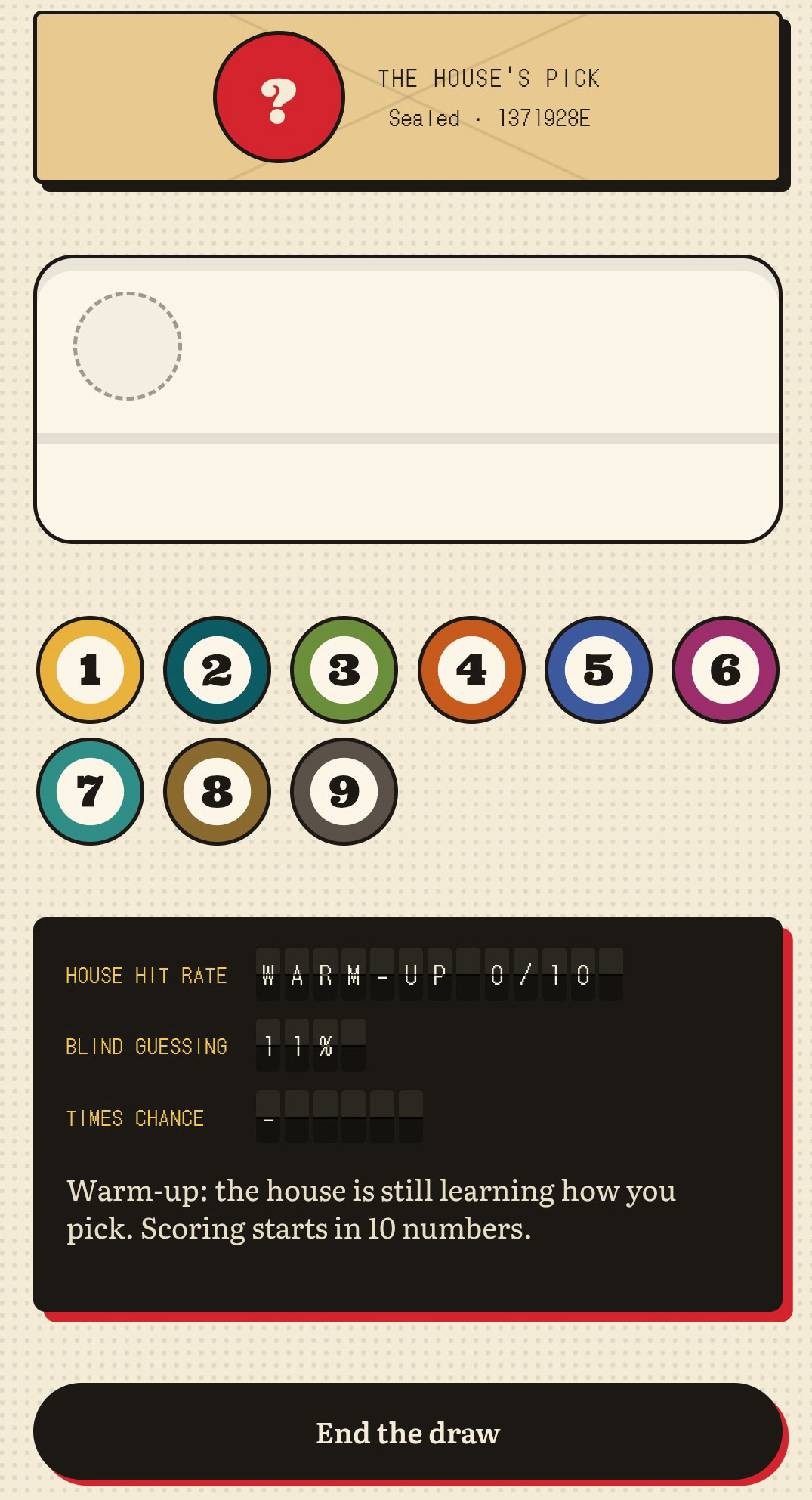
Show HN: How random are you?
A nice experiment to prove our choices aren’t that random anyway. Also loved the implementation.