Jeju Kayak Circumnavigation Challenge
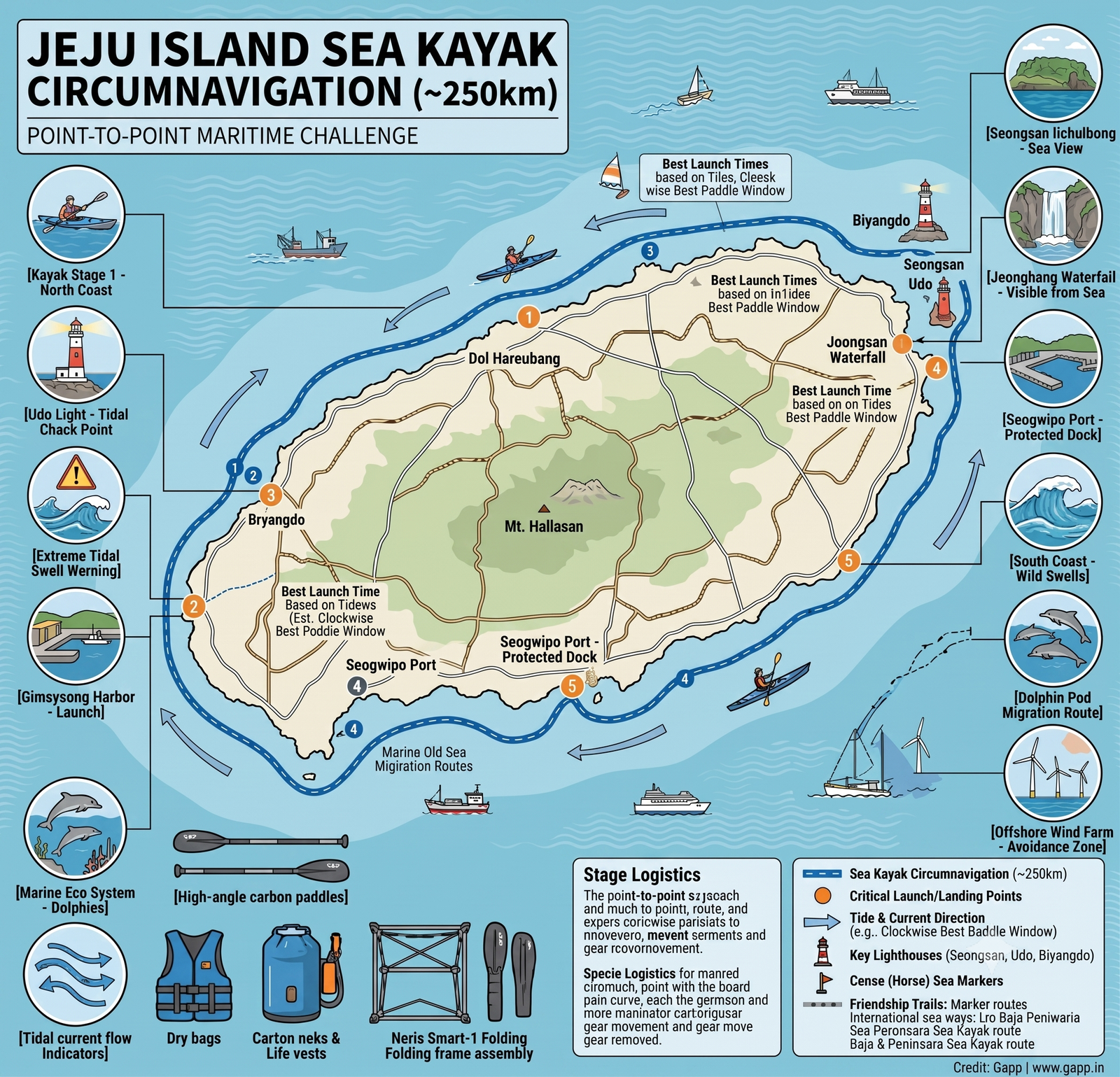
Paddling a sea kayak around Jeju Island is the toughest of the three legs in the Jeju Trifecta. The coastline is roughly 253 km. The Pacific swells on the south coast are exposed and unforgiving. The island’s nickname is Samdado (삼다도) — “the island of three abundances”: rocks, wind, and women — and two of those three are problems for paddlers.
Unlike the bike path and the Olle Trail, there is no official passport, no stamps, no certificate. You finish when you finish, and the only evidence is your GPS log.
At-a-glance
- Distance: ~253 km of coastline (more if you push out around offshore rocks and bays).
- Recommended speed: 5–6 km/h cruising in a touring kayak with a calm sea state.
- Daily realistic distance: 25–40 km. Anything more is a high-effort day even for trained paddlers.
- Total time: 5–6 weekend trips at 50 km/weekend, OR 5–7 continuous days at 40 km/day.
- Best months: Mid-May to mid-June and late September to October. Avoid monsoon (late June–mid July) and typhoon season (Aug–Sep).
- Permits: None required. Korea’s Water-Related Leisure Activities Safety Act exempts unmotorized vessels.
- Mandatory gear: PFD (life jacket — fines apply if not worn), VHF radio recommended, spray skirt for ocean swell, compass or GPS, marine flares for offshore stretches.
The four coasts — what each one is actually like
Jeju sits at the intersection of three sea regions (Yellow Sea, East China Sea, Sea of Japan). Each coast has its own personality.
North coast (Jeju City → Seongsan)
- ~65 km
- The mainland of Korea partially shields this side. Swell is moderate.
- Wide white-sand beaches (Hamdeok, Gimnyeong) make for easy landings.
- Best section to start. Build sea legs here.
East coast (Seongsan → south to Pyoseon)
- ~30 km
- Wind exposure picks up. Currents tighten around the Seongsan promontory.
- Udo Island is a short detour — paddleable on a calm day, but be aware of the inter-island ferry route.
South coast (Pyoseon → Seogwipo → Moseulpo)
- ~80 km, the most exposed and most dangerous section.
- Faces the open Pacific. Swells of 2–3 m on a clear, calm day are routine. After any low-pressure system, surf along the rocky coast becomes unlandable.
- Vertical basalt cliffs — almost no sandy bail-out beaches between Seogwipo and Moseulpo.
- Indo-Pacific bottlenose dolphins regularly accompany paddlers in this stretch.
- Plan around weather windows of ≤ 1 m swell and ≤ 15 knot wind.
West coast (Moseulpo → Aewol → Jeju City)
- ~78 km
- Famous for strong offshore winds. The west coast is where the kayak’s foot-pedal rudder system earns its keep.
- Beautiful shallow reef flats around Hyeopjae and Geumneung make for great rest stops.
- Indo-Pacific bottlenose dolphins again — there’s a resident pod that ranges between Moseulpo and Aewol.
The five-weekend section plan
Most weekend-warrior paddlers from Seoul break the loop into five legs:
| Weekend | Section | km | Character |
|---|---|---|---|
| 1 | Jeju City → Seongsan | ~55 | Calm warm-up, easy beach landings |
| 2 | Seongsan → Seogwipo | ~50 | Cliffs begin; Pacific swell starts |
| 3 | Seogwipo → Moseulpo | ~50 | The wildest section; dolphins likely |
| 4 | Moseulpo → Aewol | ~50 | Offshore wind; rudder critical |
| 5 | Aewol → Jeju City | ~50 | Reef flats, victory lap |
The advantage of weekend sections is that you can pick weather windows aggressively — if Saturday looks bad, postpone two weeks. A single continuous attempt forces you to paddle whatever the weather gives you.
Rules of the Jeju sea
The night ban (absolute)
Korean law forbids operating any leisure watercraft from 30 minutes after sunset to 30 minutes before sunrise. Jeju coastal radar towers track moving blips and the Korea Coast Guard (해양경찰) will intercept you. Penalties are real — fines of ₩300,000+ and possibly a confiscated boat.
Give Haenyeo (해녀) a massive berth
Jeju is famous for its female free-divers, who harvest abalone, sea urchin, octopus, and conch from shallow waters along the entire coast. They mark their working area with bright orange round floats called tewak (테왁) with a net underneath.
- Never paddle through a cluster of tewak. Detour wide (≥ 50 m).
- Haenyeo cooperatives have legal harvesting rights and are tightly organised. Disturbing a working dive area gets you ejected from the beach by the village fishing cooperative when you land — and the news travels around the island fast.
- Haenyeo are usually out at first light and rest mid-afternoon. Plan your tight-to-shore stretches around their schedule when possible.
Stay clear of the ferry lanes and ports
The big working ports are Jeju Port (in Jeju City), Hwasun, Aewol, Seogwipo, and Seongsan. Container ships, fishing boats, and inter-island ferries all use these. Cross ferry lanes perpendicular and quickly; don’t loiter.
Marine forecast resources
- KMA (Korea Meteorological Administration) marine forecast: www.weather.go.kr — Korean, English version exists.
- Windy.com — best for visualising swell direction and offshore wind on a map. Free.
- Korea Coast Guard advisories — VHF channel 16, or the 해양경찰 122 hotline.
- Tides — moderate around Jeju (range ~2 m, much smaller than Incheon’s 9 m). Less of a tactical concern than the wind.
Gear checklist
For each paddling day, minimum kit:
- Kayak with spray skirt (sea-touring class — see Packable Sea Kayak Selection)
- 4-piece breakdown paddle + spare paddle blade
- PFD (life jacket)
- VHF marine radio (recommended; not strictly required for daysailing close to shore)
- Compass / GPS (your phone in a waterproof case + Garmin if available)
- Marine whistle clipped to PFD
- Flares (offshore stretches)
- Bilge pump or sponge
- Dry bag with: phone, ID, ₩50,000, change of warm clothes, food, water (3+ L)
- Sun: hat, polarised sunglasses, SPF 50+, lip balm
- First aid kit (small) including blister care
- A spare tow line (~10 m)
Where to launch (each section)
- Hamdeok Beach — wide, sandy, parking, restrooms. Ideal Weekend 1 launch.
- Gimnyeong Beach — similar.
- Seongsan Sumagi (성산 수마기) — small protected cove east of Seongsan Ilchulbong.
- Pyoseon Beach — south coast, wide.
- Seogwipo (Bomokpogu) — small port; check with the harbour master before launching.
- Songaksan / Sagye Beach — southwest tip.
- Moseulpo (Hamori Beach) — southwest, sheltered.
- Hyeopjae / Geumneung — west coast, classic emerald-water launches.
- Aewol (Hagwi Beach) — northwest, sheltered.
- Iho Tewoo Beach — Jeju City, close to airport. Useful for short ride-and-finish days.
Prior expedition notes
There are no official FKTs (Fastest Known Time) for a Jeju circumnavigation. Local Korean paddlers have completed solo loops in 5–7 days; some commercial expedition outfits offer guided 6-day group trips, but these are intermittent and currently rare. If you finish solo, you are joining a very small club.
Recommended training before attempting
- Comfortable paddling 20 km in open water in moderate (10–15 knot) wind.
- Practiced a wet exit and self-rescue (re-entry from open water) at least twice in calm conditions.
- Familiar with reading swell direction and forecast charts (Windy is good practice).
- Han River paddles for fitness; coastal day trips around Taean, Namhae, or Ganghwa for sea experience.
See Kayaking in Seoul and Incheon for the Seoul-area training grounds.
Related pages
- Jeju Trifecta — the overarching project.
- Jeju Olle Trail Challenge — the walking/running loop.
- Jeju Fantasy Bike Path Challenge — the bike loop.
- Packable Sea Kayak Selection — choosing the right boat.
- Kayaking in Seoul and Incheon — training before Jeju.
- Jeju Luggage Forwarding Services — moving gear between coastal hotels.
- Gimpo to Jeju Flight Hacks — getting yourself + boat to Jeju.